In this letter, we present a hierarchical control framework that enables wheeled bipedal robots to perform planar object sliding tasks with their wheeled legs. The proposed approach formulates a nonlinear model predictive controller (NMPC) based on a reduced-order three rigid bodies (TRB) dynamical model that explicitly accounts for the hip roll degree of freedom and multiple wheel-environment contact modes, which is essential for lateral stepping and pedipulation tasks. Within this framework, the NMPC simultaneously regulates robot locomotion and interaction forces, allowing the robot to stably execute both rolling and object manipulation behaviors. A trajectory-optimization-based robot-object motion planner is developed to generate reference motions that incorporate stick-slip transitions in ground-object contact. Two representative pedipulation motions, namely scooting and lateral sliding, are validated through real-world hardware experiments, in which the robot successfully retrieves a 1 kg object from under a desk and slides a 4 kg object over a distance of 0.228 m via scooting.
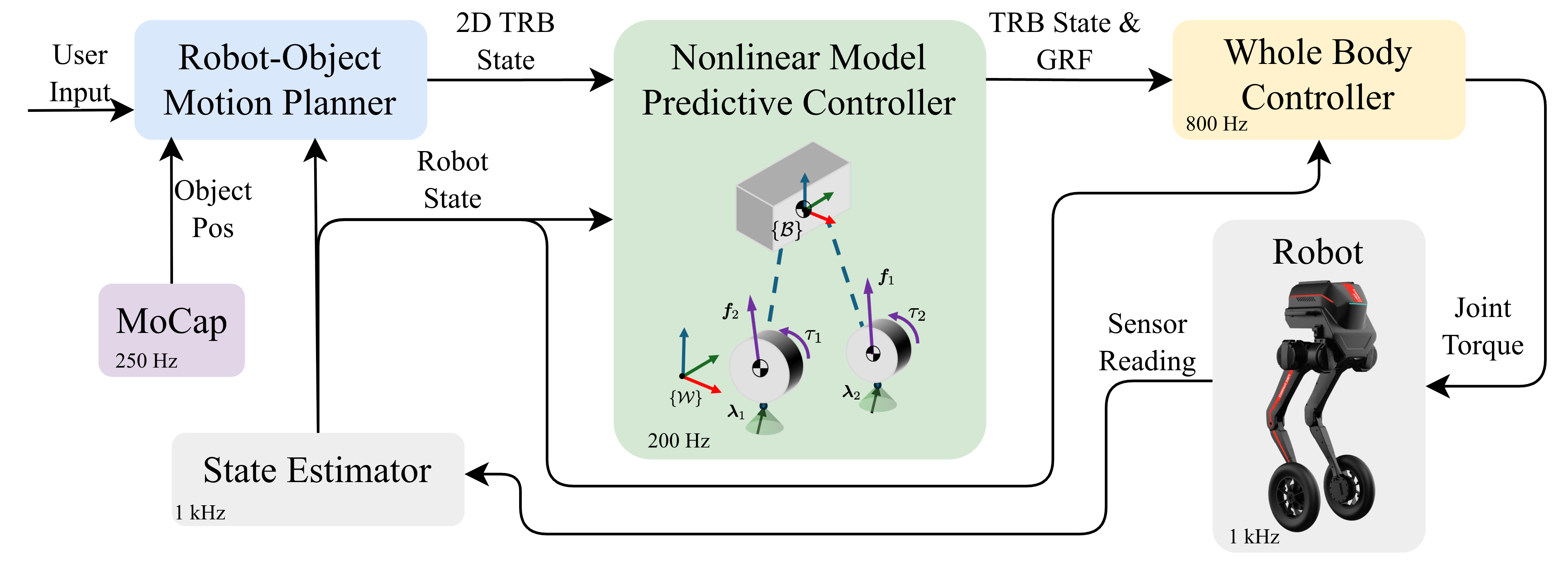
The proposed hierarchical control framework integrates robot-object motion planning, nonlinear model predictive control, and whole body control for mobile pedipulation. Given a user command and the measured object pose, the robot-object motion planner generates a 2D TRB reference trajectory using task-specific TRBO models for lateral sliding and sagittal scooting. The NMPC then tracks this reference together with the estimated robot state, computing desired TRB states and interaction ground reaction forces while coordinating wheel-leg motion. Finally, the whole body controller maps these reduced-order commands into joint torques for robust hardware execution.
We first validate the proposed hierarchical control framework in simulation, demonstrating the robot's ability to execute both locomotion and pedipulation behaviors. The simulation videos below showcase the robot's performance in executing gamepad-controlled locomotion, lateral stepping, scooting, and lateral sliding motions, highlighting the effectiveness of our control approach in enabling complex mobile pedipulation tasks.
Gamepad Controlled Locomotion
Lateral Stepping
Scooting
Lateral Sliding
Model mismatch is a common challenge in the object-oriented control of mobile manipulation, as the object properties and contact conditions can vary significantly from the assumptions made in the model. To handle this challenge, we incorporate a feedback mechanism into our framework by augmenting the NMPC formulation with an object dynamics model alongside the TRB model. This allows the controller to adapt to changes in the object dynamics and contact conditions, improving the robustness of the system to model mismatch and enabling successful execution of pedipulation tasks even in the presence of uncertainties. Below are simulation videos comparing the performance of the TRB model and the TRB with Object (TRBO) model under an object model mismatch of 1 kg.
TRB Model
TRBO Model
We validate the proposed hierarchical control framework on the Tron1 robot. Relying on proprioceptive sensor feedback, the robot stably tracks velocity commands from a gamepad controller.
Locomotion on Hardware
Locomotion Test Outdoors
Scooting motion is validated on hardware, where the robot successfully slides a 4 kg object over a distance of 0.228 m through 8 scooting cycles. The video below shows the scooting motion on hardware, along with a slow-motion version that highlights the stick-slip transitions in the ground-object contact during the scooting motion.
Scooting on Hardware
Scooting on Hardware (Slow Motion)
Combining lateral stepping and sliding, the robot can successfully retrieve a 1 kg object from under a desk, demonstrating the effectiveness of our hierarchical control framework in executing complex mobile manipulation tasks. The video below shows the underdesk object retrieval motion on hardware, along with a front view that highlights the robot's ability to coordinate its wheel-leg motion and interaction forces to achieve the desired object manipulation behavior.
Underdesk Object Retrieval
Underdesk Object Retrieval (Front View)
@ARTICLE{qin2026mopedipulation,
  author={Qin, Yue and Zhuang, Yulun and Shen, Zelin and Ding, Yanran},
  journal={IEEE Robotics and Automation Letters},
  title={Mobile Pedipulation for Object Sliding via Hierarchical Control on a Wheeled Bipedal Robot},
  year={2026},
  volume={11},
  number={8},
  pages={9787-9794},
  keywords={Contacts;Modeling;Robots;Wheels;Dynamics;Joints;Torso;Grounding;Force;Legs;Legged robot;wheeled robot;optimization and optimal control;nonprehensile manipulation},
  doi={10.1109/LRA.2026.3707348}
}