A FlowRRT search on a sloped course. The green fans are jumps the flow sampler proposes toward each sampled foothold. The final path is blue in flight and orange in stance.
This paper presents FlowRRT, a kinodynamic planner for agile monoped hopping on discrete terrain. Steering for kinodynamic RRT on complex dynamical systems currently relies on motion primitives or closed-loop policies, limiting the diversity of motions or the planning speed. Distilling a trajectory optimizer avoids both, but existing methods regress a single solution per query, which fails on monoped hopping, where the feasible action set is narrow and disconnected. Our key insight is to treat steering as set-valued and predict the distribution of feasible actions instead. A multi-start MPPI expert collects the entire feasible set of each query offline, and conditional flow matching distills it into a generative sampler. With this sampler, FlowRRT coordinates successive jumps over long horizons and finds non-greedy maneuvers that are hard for reactive policies to discover. Benchmarks across different terrains show higher success rates and substantially shorter planning times than sampling-based baselines. On terrains with inclined platforms, FlowRRT reaches 80% success within 1 s, versus 24 s for RL-RRT and 77 s for SST. Sim-to-sim tracking in MuJoCo confirms accurate execution under full-order dynamics.
FlowRRT is a kinodynamic RRT. Each node is a takeoff state and each edge is one jump. We sample footholds, a one-dimensional task space, and grow the tree in the full state space.
Each new node comes from steering, which searches for a jump from a node's takeoff state that lets the robot reach a sampled foothold. Steering runs on every iteration and is the most expensive step, so it sets the speed of the whole planner. It has to be fast, and the jumps it returns have to be ones the robot can actually make.
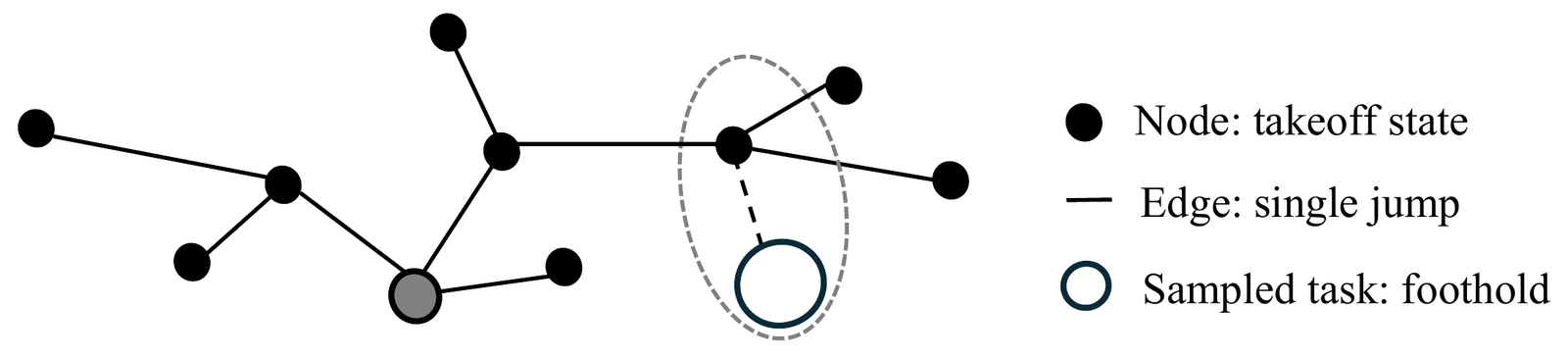
State space
x ∈ ℝ6
The CoM position, torso pitch θ and their velocities at takeoff, under a single-rigid-body model.
Action space
u = [Tfl, px, Tst, λ0, λ1] ∈ ℝ7
Flight time, foothold, stance time and two Bézier control points for the ground force. The next takeoff state x+ = F(x, u) has a closed form.
Sample space
prand ∈ 𝒫 ⊂ ℝ
A target foothold on the terrain. The tree grows toward nodes that can reach it.
Key insight
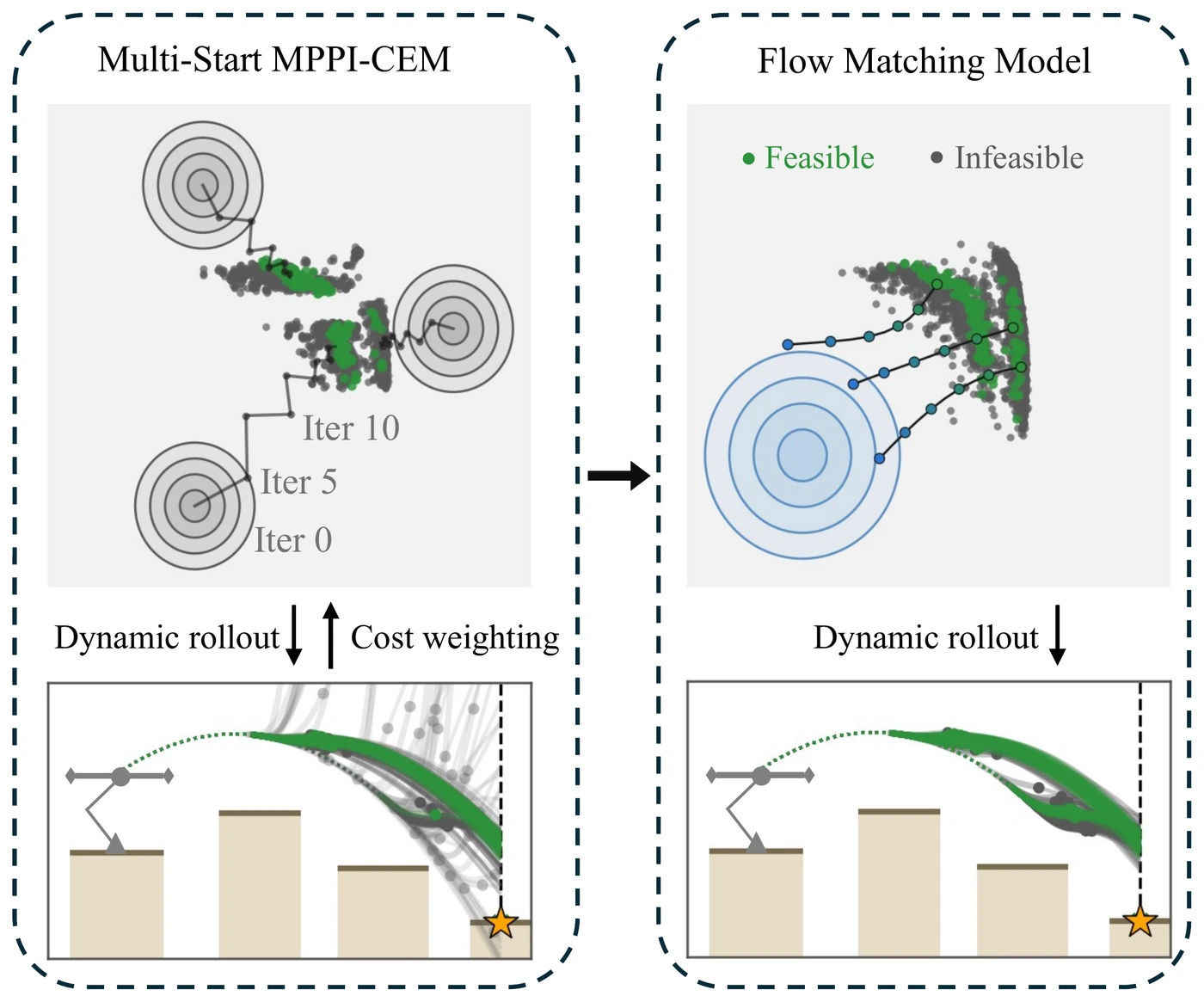
Steering is set-valued: a takeoff state can reach a target foothold through several disconnected families of jumps, so the solver should produce the whole feasible set rather than one action.
The same foothold can often be reached in very different ways, for example by planting the stance foot on different blocks. A network trained to return one action per query keeps only one of these, and its output has to jump between them as the query changes. We train on the whole feasible set instead.
Expert solver: offline, we run a multi-start MPPI-CEM solver on each query and keep every feasible jump it finds. It needs no gradients, so discrete footholds are not a problem, and the closed-form rollouts let all restarts run in parallel on the GPU. Different restarts end up in different parts of the feasible set.
Generative sampler distillation: a conditional flow-matching model learns to sample uniformly from these feasible jumps. At planning time it turns 1024 Gaussian samples into candidate jumps with 10 Euler steps in one batch, and we roll them out to keep the feasible ones.
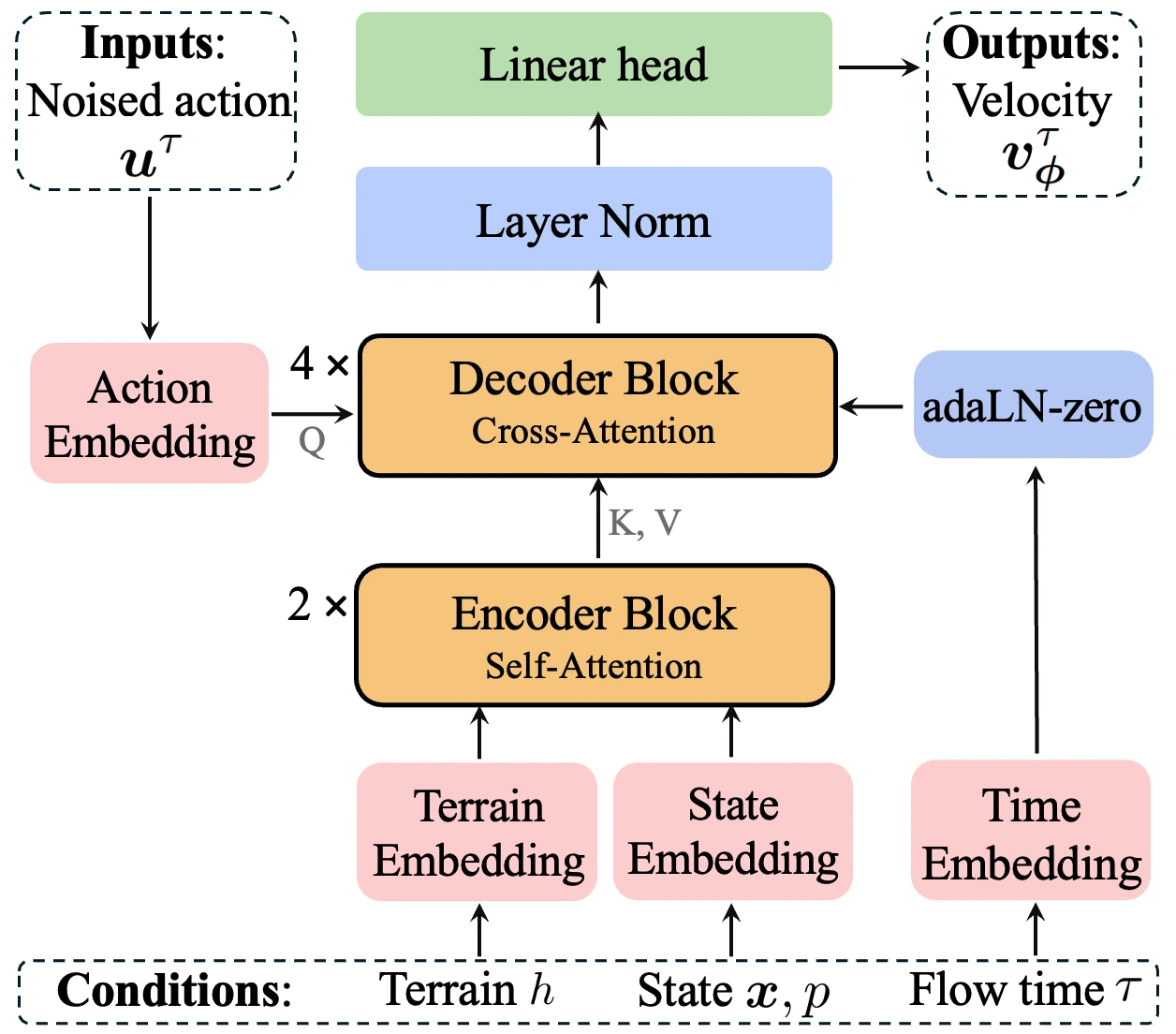
The conditions are embedded into one state–target token and one token per cell of the local height map, each carrying its position relative to the target foothold and the takeoff foot, and are encoded by two self-attention blocks.
The noised action is embedded as a single token and refined by four decoder blocks, where it provides the queries and the encoded conditions the keys and values. The flow time modulates the decoder through adaLN-Zero, and a linear head outputs the velocity.
Hidden dimension 128, four attention heads, 1.70M parameters; the height map covers [−1, 3] m in the takeoff frame at 5 cm resolution, and inference uses 10 Euler steps.
Drag a block's top to change its height, the block sideways to change the gap in front of it, or the dot on its corner to change its slope. When you let go, FlowRRT replans in your browser and the tracking policy runs the new plan in MuJoCo. Or pick one of two classic courses, planned in advance. The tracker is a whole-body motion-tracking policy we trained following BeyondMimic [Liao et al., 2025] to follow FlowRRT plans.
We compare FlowRRT with two baseline planners and with the expert it is distilled from. SST [Li et al., IJRR 2016] does not steer; it propagates the same single-rigid-body model with random controls. RL-RRT [Chiang et al., RA-L 2019] steers with a goal-reaching policy trained with PPO on the full robot, run in closed loop for up to 4 s per steer. Expert MPPI uses the multi-start MPPI-CEM solver directly as the steering function in the same planner, so comparing it with FlowRRT shows how much time distillation saves.
We run 50 random terrains per class with 5 planner seeds each, 250 runs per method. FlowRRT has the highest success rate at every time budget, and the gap is largest for short budgets. Within 1 s it solves 99–100% of gap and stones runs, while no baseline exceeds 41%. On slope it reaches 80% in 0.9 s; RL-RRT needs 24 s and SST 77 s. Drag on the chart to read other budgets.

Removing the reachability estimator (w/o reach), or replacing the flow sampler with a regressor that predicts the lowest-cost action as in RRT-CoLearn [Wolfslag et al., RA-L 2018], both increase the share of failed steers. The regressor also loses success on slope and stones, where the feasible set is narrowest.
Click a terrain to show its results in both charts.
@misc{qin2026flowrrt,
  title  = {Agile Monoped Hopping on Complex and Discrete Terrain via
            Kinodynamic Planning with Distilled {MPPI} Steering},
  author = {Qin, Yue and Cheng, Denglin and Liu, Jingyu and Ding, Yanran},
  year   = {2026},
  note   = {Under review}
}